Slipper Digital Offers All offers · Professional toolkits · Customer login
SEO
SEO OS V4.0 · Slipper Digital
Get SEO OS
SEO delivery operating system · V4.0

Stop delivering audits. Start delivering verified production change.

SEO OS connects the work most consultants still run across crawlers, spreadsheets, tickets and client decks: crawl the site, collect evidence, review candidate findings, prioritize what matters, propose the fix, deploy only what you approve, then recrawl production to prove the approved change actually landed.

Local-first. Human approval at every execution gate. Not a rank tracker. Not an autonomous SEO agent.
REALCloudflare production publish, recrawl and rollback verified (V3.1.3 pilot, V3.1.4 and V4.0 live sites)
121automated release tests passing in V4.0 (15 Oct 2026)
12browser checks in Microsoft Edge (15 Oct 2026)
0known package vulnerabilities reported by npm audit (15 Oct 2026); not a security warranty
The delivery problem

The expensive part of SEO is not finding issues. It is getting the right fixes shipped, and proving they were shipped correctly.

A conventional audit can end with sixty findings, a slide deck, and a client who intends to “get started.” Three months later, a handful are closed, nobody can clearly prove what changed in production, and SEO is left explaining why the numbers have not moved.

OLD WORKFLOW

Evidence gets separated from execution.

Crawler output lives in one tool. Priorities live in a spreadsheet. Developers receive abbreviated tickets. “Done” means somebody closed a task, not that production matches the recommendation.

SEO OS WORKFLOW

One record survives from detection to validation.

The finding keeps its evidence, business consequence, priority, proposal, approval state, deployment record, rollback snapshot and production QA result.

The operating model

One workspace from observed evidence to verified implementation and measured outcomes.

Automation does the mechanical work. Consultant judgment remains the gate. SEO OS is deliberately designed so a detector cannot silently become a deployment.

01

Diagnose

Crawl, technical evidence, candidate findings and search-condition signals enter the 9-step diagnostic system.

02

Prioritize

Search, analytics and business context help separate commercially important problems from cosmetic noise.

03

Plan

Accepted findings become initiatives, roadmap lanes, tickets and content or technical decisions.

04

Execute

Approved proposals go through connector capability checks, drift checks, dry run and explicit human approval.

05

Validate

The live page is recrawled. Released and Validated remain separate states until production matches what was approved.

Crawl→ Evidence→ Candidate→ Consultant gate→ Diagnosis→ Proposal→ Approve→ Dry run→ Deploy→ Recrawl→ Validated

API success is not production validation. If a CMS or deployment API says “200 OK,” SEO OS still checks the live page. The approved title, description, H1, canonical, robots directive, schema, body section or internal link has to be observed in production before the work reaches Validated. Validated means production matches the approved change. Whether rankings, clicks or AI visibility improve is a separate question, measured afterwards with its own evidence.

Production proof · V3.1.3 and V3.1.4

A real Cloudflare pilot changed a live site, verified it, rolled it back, and exposed a defect before release.

This was not a screenshot demo or mocked deployment. A throwaway Cloudflare project was used so the full connector path could be exercised without touching an existing site.

4/4

approved changed fields verified after the final rollback fix

  • Real wrangler whoami succeeded through the product.
  • Live site crawl covered 4 URLs and produced 5 candidate findings.
  • 3 meta-description proposals and 1 H1 demotion were approved.
  • Whole-folder dry run confirmed 5 of 5 publishable files matched the live target before deployment.
  • A real Cloudflare publish recorded the deployment and version information.
  • Automatic recrawl confirmed the production changes; an independent live fetch confirmed the new descriptions and the demoted H1.
  • Rollback republished the original site and restored both the absent descriptions and original H1 structure.

The pilot found a rollback-verification defect. That is the point of a real pilot.

Three pages originally had no meta description. The first rollback verifier silently omitted fields whose original value was absent, so it could have reported success while an added description remained live. V3.1.3 changed rollback expectations so “originally absent” is an explicit state to verify. The pilot was then rerun against the fixed build and all four changed fields were checked.

A tool that can change production should be judged by how it handles drift, uncertainty, rollback and proof, not by how confidently it says “deploy complete.”

V3.1.4 on a live site (28 September 2026). The packaged release changed a title on slipperdigital.com, an assets-only Cloudflare Worker: the dry run matched 80 of 80 deploy-folder files against the live site, the change was published, production validation passed, and the rollback was published and verified. This was repeated the same evening. Watch the recorded run and read what it does and does not show.

V4.0 on a live site (10 October 2026). The packaged 4.0.0 service published a body section and an internal-link placement to a live production page through the Cloudflare connector (a Worker with static assets): the dry run matched all 64 deploy-folder files against the live site, the production recrawl validated both changes, and the rollback was published and verified. The same changes were then published again and kept live.

V4.0 boundary. That production proof is for the Cloudflare connector. WordPress body editing is tested against a simulated WordPress, and the GitHub connector has not been run against a real repository.

Audit coverage

Mechanical evidence gathering is automated where the evidence is observable. Judgment stays manual where it should.

Policy & discoveryRobots.txt analysis, sitemap validation, crawl scope and crawlability.
Status & redirectsFailed requests, broken internal links, redirect chains and loops.
RenderingRendered title, canonical, H1 and main-text changes plus render errors on sampled pages.
IndexationNoindex exposure, canonical conflicts/chains, soft-404 heuristics and indexability loss.
ArchitectureClick depth, inlinks, orphan signals and faceted/parameter patterns.
Sitemap qualityNon-200, redirected, noncanonical or non-indexable URLs in sitemaps.
PerformancePageSpeed / CrUX evidence where available; lab evidence remains diagnostic.
On-pageMetadata, H1 and structured-data checks tied back to page evidence.
Search intelligenceDecay, CTR shortfall, cannibalization, striking-distance and zero-click hypotheses.
Commercial contextSearch and analytics inputs can raise or lower the priority of the same technical finding.

Automatic Pass is intentionally restrained. SEO OS only creates a defensible automatic pass when the crawl completed within scope and the detector actually has enough evidence. Policy, authority, business intent, content quality and several rendering or measurement questions remain consultant decisions.

Optimization & execution

Move from “fix this” to a controlled proposal with evidence, risk, approval and production proof.

SEO OS generates rule-based proposals for titles, meta descriptions, H1s, canonicals, robots/indexing directives and structured data. New in V4.0: body sections you write, or paste from an approved content brief, and internal links placed on a phrase that appears exactly once in a page's main content. They pass through the same drift check, approval, validation and rollback. SEO OS does not write the copy.

Drift detectionBefore deployment, compare current production with the value that was reviewed. If another person changed the page, stop instead of overwriting blindly.
Connector capability enforcementEach connector exposes the fields it can actually change. Unsupported operations are rejected before a write is attempted.
High-risk confirmationCanonical and robots/indexing changes require additional confirmation and a validated pilot of no more than five URLs before broader rollout.
Pre-write snapshotsCapture the original state before changes are written so rollback is based on recorded evidence rather than memory.
Targeted validationRecrawl only the changed production pages and compare observed values with the approved expectations.
Rollback verificationVerifies both restored values and fields that are supposed to be absent again, including added sections and links.
Body sections (V4.0)Replace the content of an element by its id, or add a section after it. Plain content only: scripts, styles, forms, images and H1s are refused, not silently removed. Rollback restores the original markup byte for byte.
Link placements (V4.0)An internal-link recommendation becomes a deployable link only on a phrase that appears once in the main content, outside navigation, headings and existing links. Rollback removes exactly that link.
AI referral traffic (V4.0)Visits from ChatGPT, Perplexity, Copilot, Gemini and Claude by landing page, with key events and revenue, from GA4. A floor: assistants that send no referrer arrive as direct.
Value ranking (V4.0)Pages ranked by what closing their search gap is worth: potential clicks times revenue or key events per session, with every input shown.
Why traffic changed (V4.0)For each page that lost clicks, the causes your data supports, with evidence: indexing, a deploy, click-through, position, demand or another page taking its queries, plus any Google update in the window.
Near-duplicate check and pilot gate (V4.0)Pages that share most of their text are grouped before they read as scaled content, and bulk approval releases a pilot of 25 first.
Server logs (V4.0)Which pages Googlebot and Bingbot actually requested, from your access log, with no IP addresses kept.
SEO OS 4 with GEO OS

Search results and AI answers in one loop: see the gap, improve the page, ship it, watch what happens.

GEO OS is a separate product that works with SEO OS. It watches how AI answers and Google treat a brand, turns a commercially important question into a reviewed content brief, and hands the approved content to SEO OS, which ships it and proves it is live. Each measure stays its own line: nothing is blended into one visibility score.

AI answer visibilityHow often answers on ChatGPT (OpenAI), Google AI Overviews and Perplexity mention your brand and cite your pages, per question group, with sample sizes and intervals. Surfaces are never blended.
Competitors in answersAnswers that name only you, only a competitor, both or neither; which domains are cited, counted once per answer; sources an answer read but did not cite, kept apart.
Sampled Google rankYour and your competitors' organic rank from the Google results already collected, kept separate from Search Console average position. Not a daily rank tracker.
Slip alertsAn alert when a tracked page or question loses Search Console clicks, impressions or position between two comparable periods, when your sampled Google rank falls on two searches in a row, or when a competitor starts ranking above you. Observed changes, not causes; each alerts once, to Slack or a signed webhook.
Answer and fix alertsAn alert for a confirmed change in AI answers, for a harmful answer about your brand, and when an approved fix disappears from the live page after a later release.
Content workbenchOne page per buyer question, with a check for questions that duplicate an existing page. Competitor pages captured safely for structure, a reviewed list of what to cover, registered facts, an original-evidence checklist and a readiness checklist instead of an unexplained score.
Hand-off to SEO OSThe approved brief's content goes to the SEO OS section editor as a file with its plan, brief version, approver and content hash. Each factual statement in that content is first reviewed in GEO against registered evidence, and the review travels with the file. SEO OS checks the hashes, shows the review and applies its own content rules, drift check, deploy, validation and rollback.
Earned coverageThird-party pages buyers rely on, such as directories, comparisons and community answers, tracked as factual corrections or genuine contributions for a person to pursue. Never bought links or fake reviews.
Outcome reportsBefore and after the verified change, line by line: AI mentions, AI citations, sampled rank, Search Console for the page and for the question kept apart. Reviewed by a second person before a client sees them.

Status. GEO OS is built and tested on demonstration data. Live AI-answer and Google collection starts with its first pilots, and its connectors have not yet run against real client accounts. It does not write copy, does not give a content score, and does not promise rankings or AI recommendations: it shows what changed, and the grade of evidence behind any claim that a change caused it.

Execution connectors

Supported does not mean “all equally proven.” The page tells you exactly where each connector stands.

ConnectorWhat SEO OS doesVerification statusBody sections and links (V4.0)
Cloudflare Workers + static assetsWhole-folder drift/deletion preflight, Wrangler publish, live recrawl, rollback and rollback verification.Live pilot passedVerified on a live production site (10 October 2026)
Cloudflare PagesSupports existing classic Pages projects through the configured Pages target.Supported pathSupported path
Local static sitesDirect controlled file edits with snapshot, rollback and recrawl validation.End-to-end testedEnd-to-end tested
WordPressControlled REST-based updates, including connector-specific robots handling where supported.Mocked, not live-testedSupported, keeping block-editor blocks valid; tested against a simulated WordPress, not yet a real site
ShopifySEO title and meta description of products and custom collections; the H1 through the product or collection title.Mocked, not live-testedNot supported
GitHub pull requestPackages approved change work into a reviewable PR workflow.Not live-testedSupported, not live-tested
Signed webhookDelivers approved change payloads to a customer-controlled endpoint.Mocked receiver onlyNot supported

Proof is recorded connector by connector. Supported means the connector passes the automated tests. Only the Cloudflare Worker with static assets has been proven on a production site. Body sections and links work through the static folder, Cloudflare, GitHub and WordPress connectors.

Everything in the operating system

More than a crawler. More than a deployment script. The client-delivery system around both.

Discovery & engagement contractClient intake, business objectives, scope, access, ownership, success horizon and automation authority.
Baseline scorecardBusiness, search, visibility, indexation, technical, content, authority and implementation baselines.
Site Audit engineReal HTTP crawl, optional rendering samples, evidence-backed candidates and restrained automatic Pass logic.
Search IntelligenceCSV or implemented Google connections for GSC/GA4 data, commercial weighting and opportunity detection. V4.0 exports Search Console rows in the format GEO OS imports.
Issue registerEvidence, affected scope, consequence, action, owner, dependency, acceptance criteria and lifecycle.
Demand intelligenceKeyword and cluster prioritization by intent, business fit, commercial value and conversion potential.
Content decisionsKeep, Update, Consolidate, Reposition, Noindex, Redirect, Remove or Create, with rationale.
ICUE roadmapImpact × Confidence × Urgency divided by Effort, plus P0 risk overrides and initiative tracking.
Optimization proposalsCurrent value, proposed value, rationale, expected effect, risk, source finding and affected URLs.
Developer ticketsProblem, evidence, desired behaviour, implementation notes, acceptance tests, rollback and monitoring instructions.
Production QAReleased and Validated are separate states. QA gates prevent “ticket closed” from becoming false proof.
Scenario forecastsLow/base/high scenarios with assumptions, confidence, ramp-up and break-even rather than false precision.
Executive reportingBusiness outcome, search performance, diagnosis, delivery, risk/opportunity and decisions required.
12-week delivery playbookA field-ready engagement sequence plus retainer operating cadence.
Quality gateComputed and judgment-based criteria that force known risks to be addressed or consciously accepted.
Change & experiment logWhat shipped, what production did afterward and what the engagement learned.
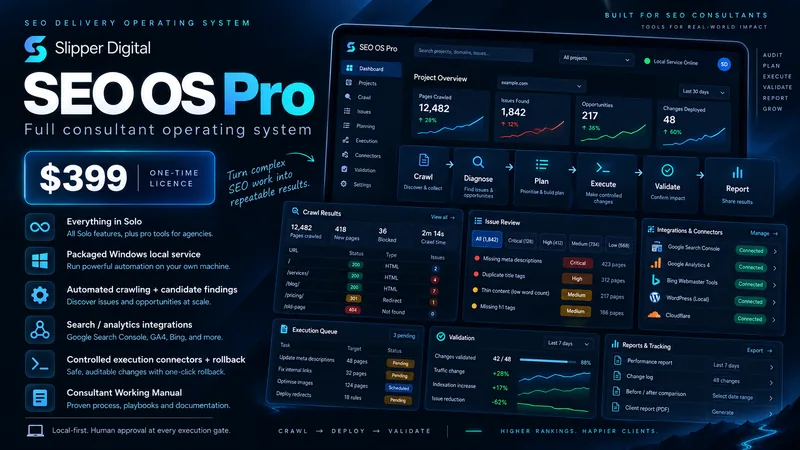
Local-first by design

Your client's operating data does not need to pass through a Slipper Digital server.

The workbench runs in the browser. Crawling, rendering and connector execution run through the local companion service or an approved private host. Credentials stay with the operator. On Windows, the Professional package includes the service and rendering runtime.

Portable when you need it. The standalone workbench opens as a local HTML application. Live crawling, rendering, Google integrations and execution require the local service.

Release verification

V4.0 release checks, and the boundaries that remain.

  • 121 automated tests passing: core, web and service (15 Oct 2026).
  • 12 browser checks in Microsoft Edge (15 Oct 2026).
  • Lint clean; npm audit reported 0 known vulnerabilities (15 Oct 2026). A past scan is not a current security warranty.
  • Body sections and link placements: dry run, deploy, recrawl validation, rollback and rollback verification tested end to end through the static-folder connector and against a simulated WordPress (block-editor and classic content, shortcodes, a content filter), and walked through in the browser on a local test site; on 10 October 2026 published, validated by production recrawl, rolled back with the rollback verified, and republished on a live production site through the Cloudflare connector.
  • V3.1.4: real Cloudflare publish, production validation, rollback and rollback validation on a live site (28 September 2026).
  • V4.0: a body section and an internal-link placement published to a live site through the Cloudflare connector, validated by production recrawl, rolled back with the rollback verified, then published again and kept (10 October 2026).

Still not live-verified: V4.0 body sections and link placements on a production WordPress site or through a real GitHub repository, real Google OAuth/Search Console/GA4, PageSpeed with a real API key, production WordPress, production Shopify, a real GitHub PR lifecycle and real webhook receivers. The Windows executable is unsigned, so Windows may warn on first run. Very large 100,000+ URL sites, authenticated sites and difficult JavaScript-heavy production stacks have not yet been load-tested.

Choose your edition

Start with the operating depth you actually need.

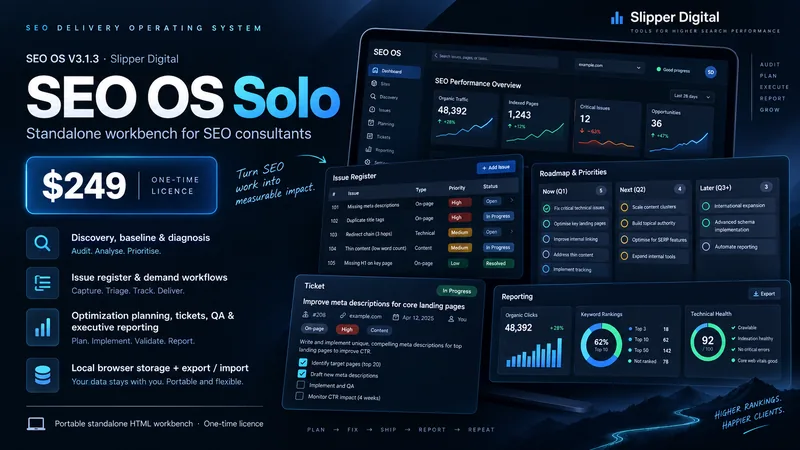
SEO OS Solo edition overview

Illustrative artwork. Screens and figures are examples, not product screenshots.

SEO OS Solo

$249
one-time licence · standalone workbench
  • Portable standalone HTML workbench
  • Discovery, baseline, diagnosis and issue register
  • Demand, content, roadmap and delivery workflows
  • Optimization planning, tickets, QA and executive reporting
  • Local browser storage and export/import workflow
  • Consultant Working Manual
Get Solo

Standalone alone does not run the crawler or execute production changes.

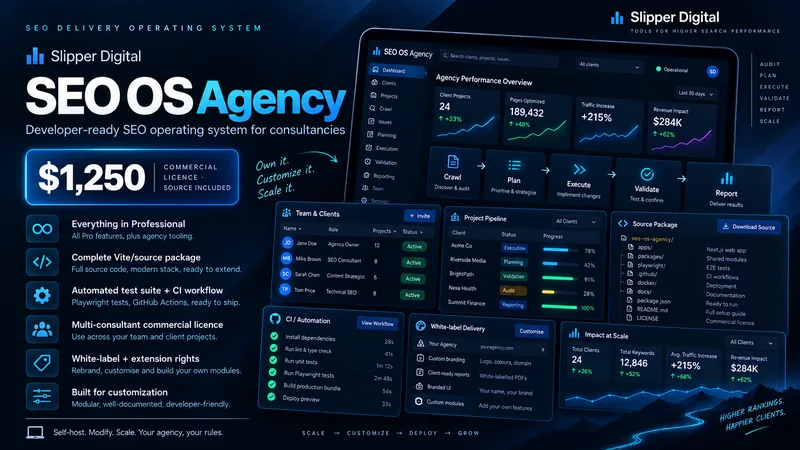
SEO OS Agency edition overview

Illustrative artwork. Screens and figures are examples, not product screenshots.

SEO OS Agency

$1,250
commercial licence · source included
  • Everything in Professional
  • Complete Vite/source package
  • Automated test suite and CI workflow
  • Multi-consultant commercial licence
  • White-label and extension rights
  • Self-hostable compiled front end
  • Developer-ready architecture for customization
Get Agency

For consultancies that want to operate, extend or brand the system across multiple consultants.

14-day fit guarantee. Run one real audit through SEO OS. If you have a compatible controlled target, run one approved fix through the deployment and validation workflow. If the system has not earned a place in how you deliver client work within 14 days, request a refund.

30 days of support. Every edition includes 30 days of email help from the date of purchase, with installation and with defects in SEO OS itself. Write to [email protected]. Support does not include custom development or work on your client sites.

Fit

Built for consultants who care about the handoff between “we found it” and “production is correct.”

This is for you if…

  • You already know SEO and want a repeatable delivery operating system.
  • Your audits regularly turn into developer tickets and multi-week implementation work.
  • You manage several clients and need evidence, ownership, QA and reporting to share one state.
  • You want automation to remove mechanical work without surrendering consultant approval.
  • You care whether a recommendation actually reached production exactly as approved.

This is not the right fit if…

  • You mainly need a keyword database, backlink index or daily rank tracker.
  • You want an autonomous agent that publishes SEO changes without review.
  • You require live proof on your exact CMS before testing the product yourself.
  • You require a code-signed Windows executable today.
  • You expect a tool to replace business judgment, content judgment or search-policy interpretation.
FAQ

Questions a serious consultant should ask before putting software near a client site.

What support do I get?

30 days of email help from the date of purchase, on every edition: getting SEO OS installed and running, and defects in SEO OS itself. It does not include custom development, changes built for your workflow, or work on your client sites. Write to [email protected].

Is SEO OS an autonomous SEO agent?

No. Candidate findings require consultant review before they become accepted diagnoses, and proposals require explicit approval before execution. High-risk canonical and robots/indexing changes have an additional confirmation/pilot gate.

Has SEO OS actually deployed to a real production platform?

Yes. V3.1.3 completed a real Cloudflare Worker/static-assets pilot, and V3.1.4 published a change to a live site twice, validated it and rolled it back. On 10 October 2026 V4.0 body sections and link placements were published to a live production site through the Cloudflare connector, validated, rolled back and republished. They have not yet run on a production WordPress site.

Does SEO OS write content for me?

No. You write a body section, or paste it from an approved content brief. SEO OS checks that it is plain content, checks that the live page has not changed since the proposal was written, deploys it through a supported connector and proves it is live. It does not claim the change will improve rankings: that is measured afterwards.

What if the site changed after I approved a proposal?

SEO OS performs a drift check before writing. When the current production value no longer matches the value the proposal was based on, the system stops for review rather than blindly overwriting another change.

How does rollback verification work?

A pre-write snapshot records the original state. After rollback, SEO OS recrawls the affected live pages and checks the original expectations. V3.1.3 specifically verifies fields that were originally absent as well as fields that had an original value.

Do I need code to use Professional?

No. Professional is intended as a packaged consultant product. Source code is part of the Agency edition for organizations that want to customize or white-label the system.

Does the standalone file run the crawler?

No. The standalone HTML is the portable workbench. Crawling, JavaScript rendering, Google integrations and connector execution are performed by the local companion service. Professional includes the packaged Windows service.

Does SEO OS replace Ahrefs, Semrush or a rank tracker?

No. Those products can remain useful data sources. SEO OS is the delivery operating system that organizes evidence, prioritization, proposals, execution, QA and reporting around the client engagement.

Will I be told when a page slips or a competitor overtakes me?

With GEO OS, yes, for the pages and questions you track: a Search Console drop between two comparable periods, a sampled Google rank fall on two searches in a row, or a competitor now ranking above you. Each alerts once, to Slack or a signed webhook. SEO OS on its own flags content decay and CTR shortfalls as findings to review, not as alerts.

Where does client data go?

The architecture is local-first. The workbench and companion service are designed to run under the consultant's control rather than route the engagement through a Slipper Digital application server. External providers receive only the data necessary for the connection you explicitly configure.

What remains unproven?

Real production testing remains outstanding for V4.0 body sections and link placements on WordPress and GitHub, Google OAuth/Search Console/GA4, keyed PageSpeed, WordPress, Shopify, GitHub PRs and webhook receivers. The Windows executable is unsigned, and very large or heavily authenticated/JavaScript-dependent sites have not yet been load-tested at enterprise scale.

The standard

Finding an SEO issue is not the finish line.

The work is finished when the right change has an owner, the implementation is controlled, the production state is verified, and the result can be explained to the client without reconstructing the story from six separate tools.