A buy button that looked perfect and went nowhere.
We broke the buy button on a page of our own live site on purpose, deployed it, and left it broken until Frontend Sentinel noticed by itself. Then we deployed the fix, and nobody closed the incident: Sentinel closed it once it had seen the repaired page working, twice, on desktop and on mobile.
2 minutes 28 seconds · silent · from the alarm to the verified close · nothing loads until you press play
Every pixel the same. Only the destination was gone.
The Lab keeps one page that exists only to be broken. It sells nothing, nothing links to it, and search engines are told to ignore it. Its button normally opens a stand-in checkout page on the same site.
For this drill the button's link was changed to href="#" and the page was
deployed to production. This is what a visitor saw: a normal page with a normal
green button that does nothing when clicked. The page returns 200 and loads
quickly, so an uptime monitor stays green. It is the same kind of fault we found by
hand on our own sites in September: buy buttons linked to nothing, and buttons opening
the wrong product's checkout.
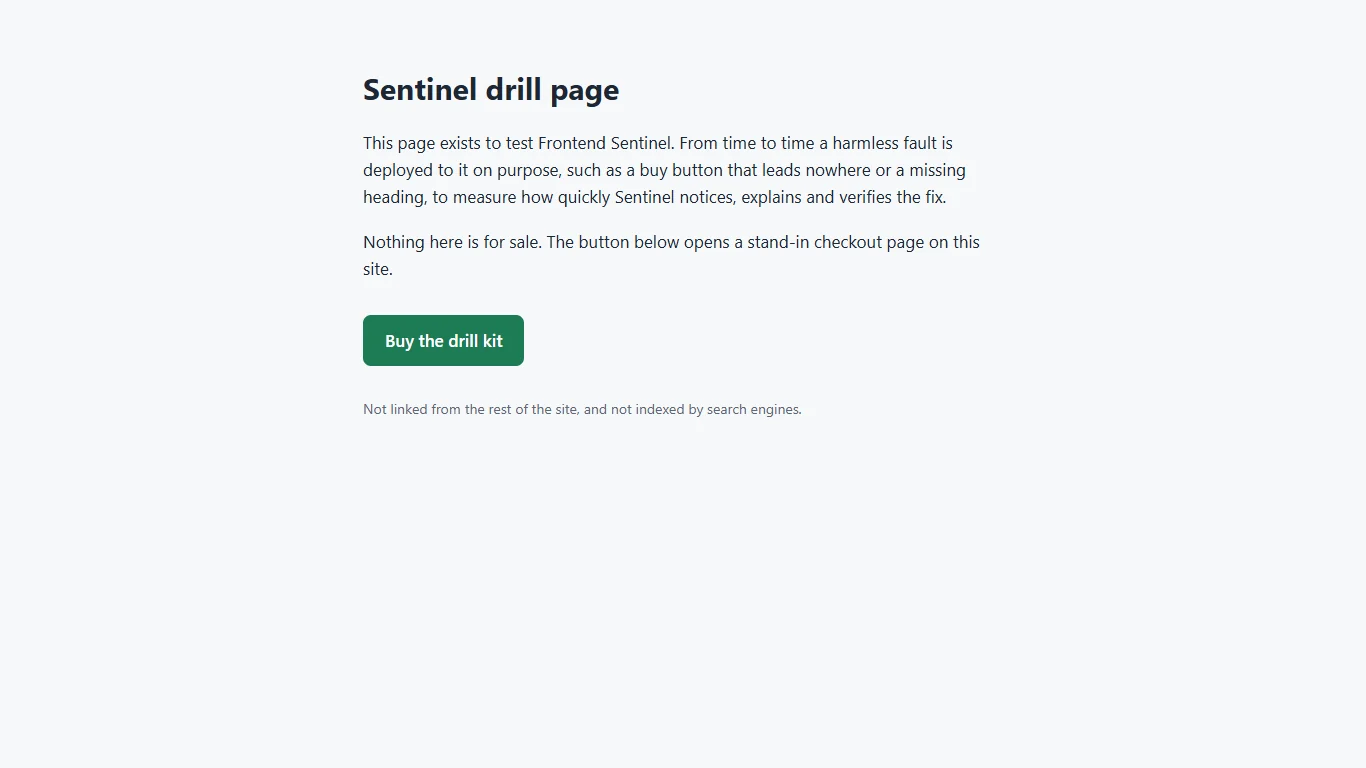
lab.slipperdigital.com/sentinel-drill · while the fault was live
The deploy is reported, the way a pipeline would report it.
As soon as the broken page was live, the drill told Sentinel a release had gone out, marked as seeded: a fault planted on purpose, so it is scored in the reliability measurement and never confused with real drift. A release notice makes Sentinel run the site's most important checks straight away instead of waiting for the next scheduled run.
The screen was captured after the drill, so it already shows the second release too: the fix, deployed a little under two minutes later. Releases marked observed further down are ones nobody reported; Sentinel noticed the pages change between two runs and logged them itself.
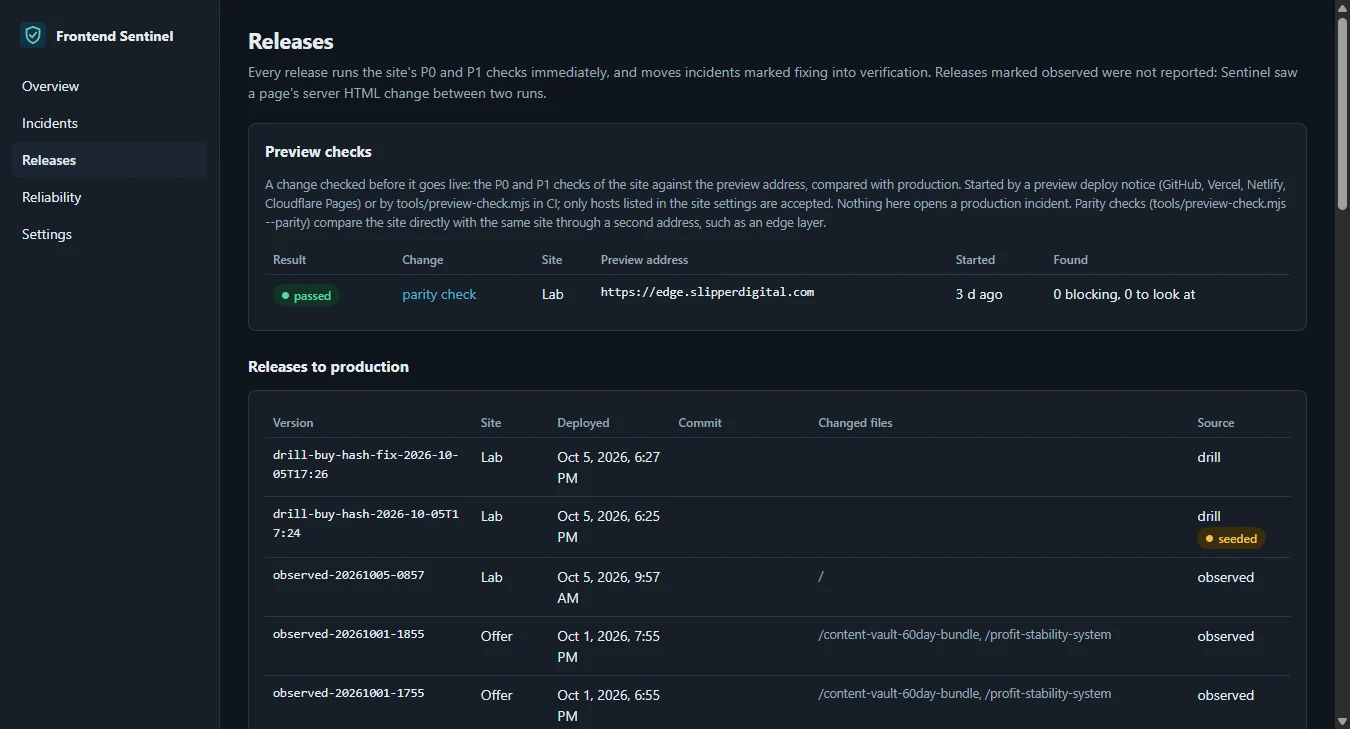
Releases · the seeded fault and its fix
A critical incident, before anyone looked.
1.92 minutes after the broken page went live, a new incident sat at the top of the list: Buy link goes nowhere, priority critical, because it is a buying step on a check marked revenue-critical. A Slack alert went out at the same moment.
The seven other open incidents on the list are real and unrelated: page-speed readings on other sites, a cookie-consent finding and a layout shift. They were left exactly as they were for the recording.
- Time to incident
- 1.92 min
- Priority
- Critical
- Detector
- Buy link goes nowhere
- Alert
- Slack, on opening
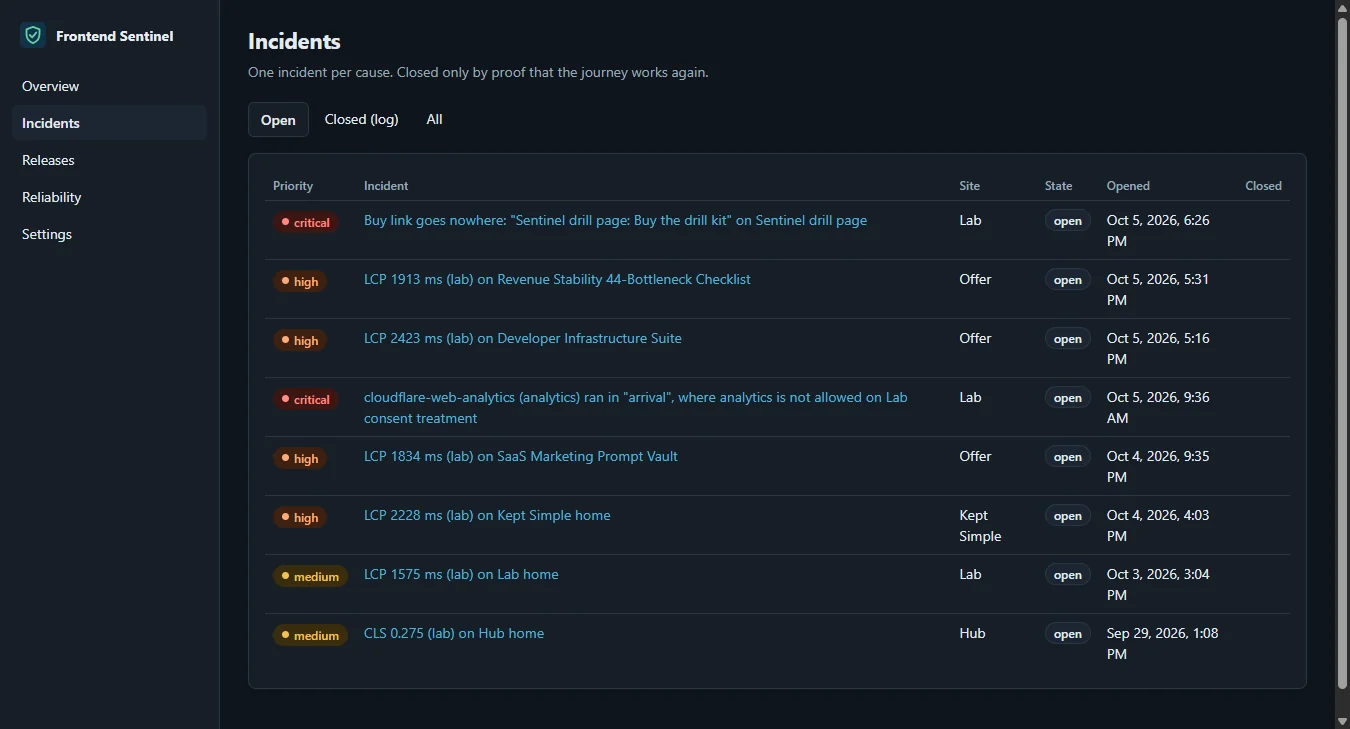
Incidents · open
What broke, where, after which deploy, and how sure it is.
The incident explains itself in plain language: on desktop and on mobile, the buy
control has href="#" and opens nothing. It names the deploy the failure
began after, and it is careful about how firmly it says so. The attribution reads
"timing only", because the first failing run came right after that release but
no changed file in it could be matched to the button. Sentinel states how sure it is
rather than sounding certain.
It also links the last time the same fault happened, on 1 October, and how that one was fixed. The "observed changes" panel lists one more difference from the approved reference: our own analytics script, added to the site after that reference was taken. It is not part of the fault, and Sentinel does not blame it; it lists it as something to look at.
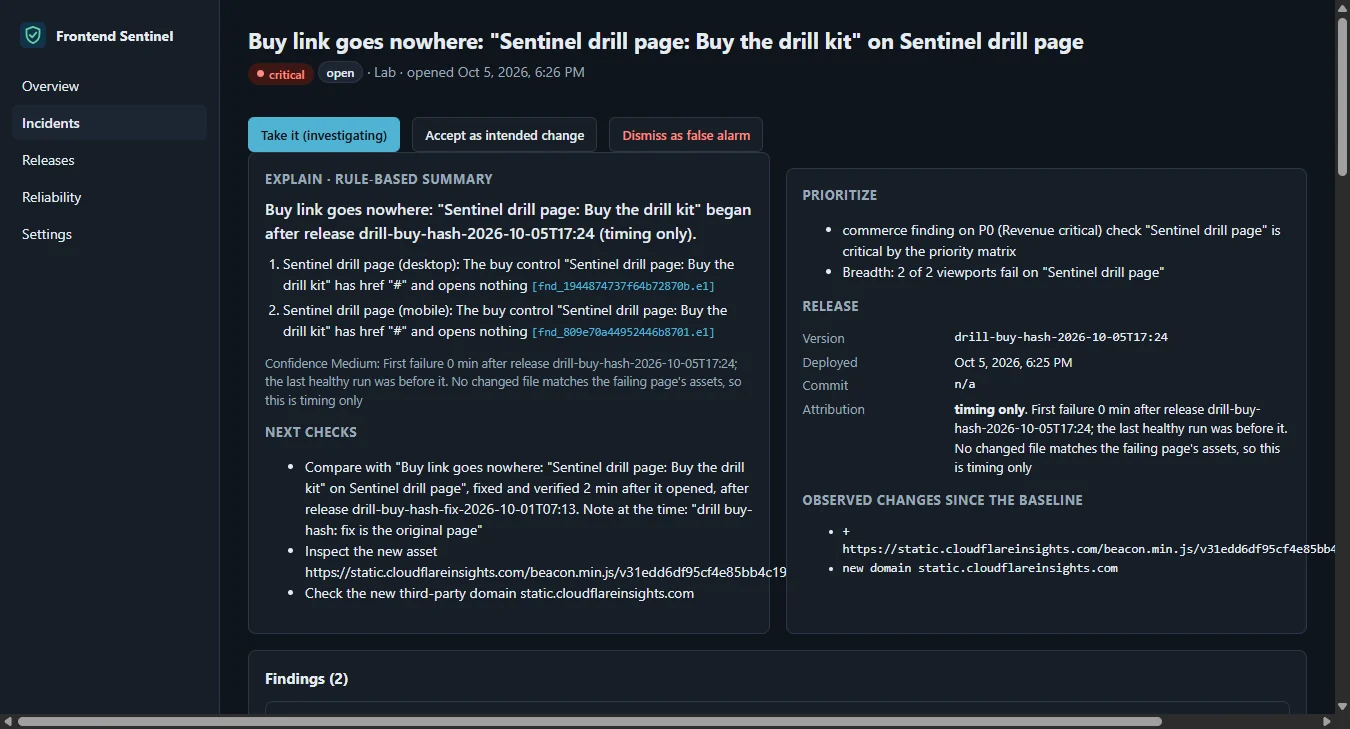
Incident · open, with its explanation
Checked twice, against an approved reference.
Nothing becomes an incident on one bad reading. Each finding was reproduced 2 of 2 times, in a fresh browser, before anyone was alerted, because a monitor that cries wolf gets muted within a month.
Each finding sets what was observed (href="#") against what was expected
(a working checkout link), with screenshots of the approved reference and of the
failing run side by side. They look identical, which is the point: this fault is
invisible in a screenshot and only shows up when you check where the button goes.
Comparing against an approved reference, not against yesterday's page, also means an
intended redesign would not raise the alarm.
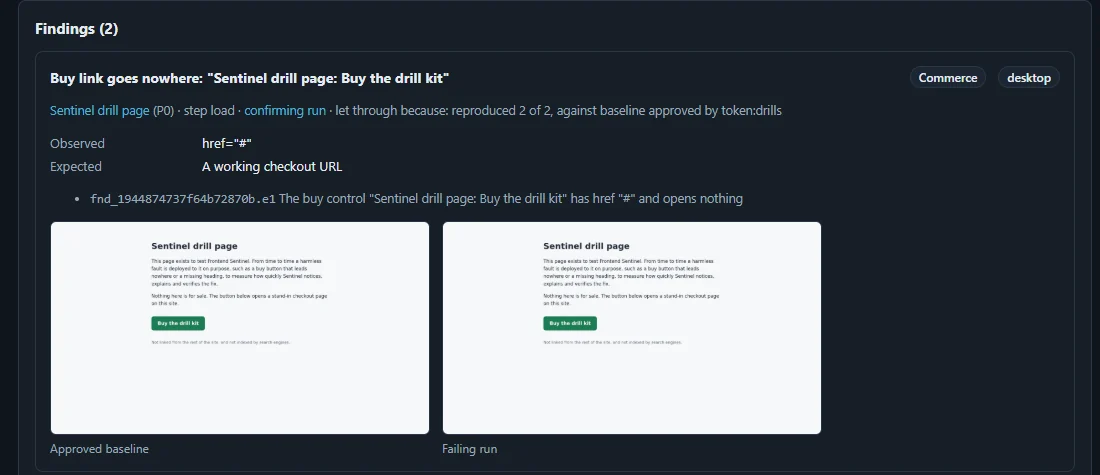
Findings · desktop, approved baseline beside the failing run
Closed only after the fix was seen working.
The drill then put the original page back and deployed it, standing in for the engineer who would normally do that. The fix release moved the incident into verification. Nobody pressed "resolve". Sentinel ran the checks again and waited for two healthy runs on each affected viewport: desktop 1 of 2, mobile 1 of 2, desktop 2 of 2, mobile 2 of 2. Only then did it close the incident and send the resolved alert.
The timeline keeps every step with its time and who did it, and the incident keeps its evidence after it closes: an evidence pack can be exported as PDF, HTML or JSON for anyone who needs the record later.
- Fix live to closed
- 1.4 min
- Healthy runs needed
- 2 per viewport
- Closed by
- Sentinel
- Opened to closed
- 1 min 49 s
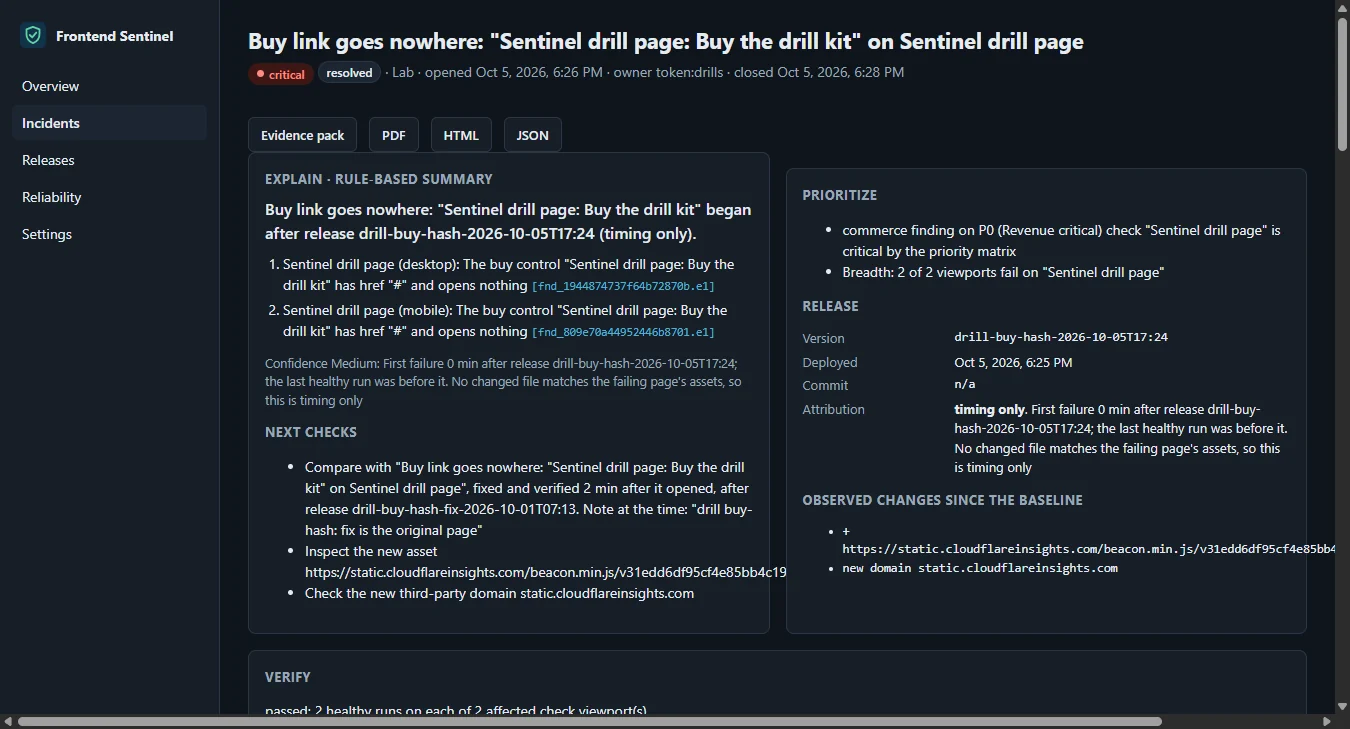
Incident · resolved
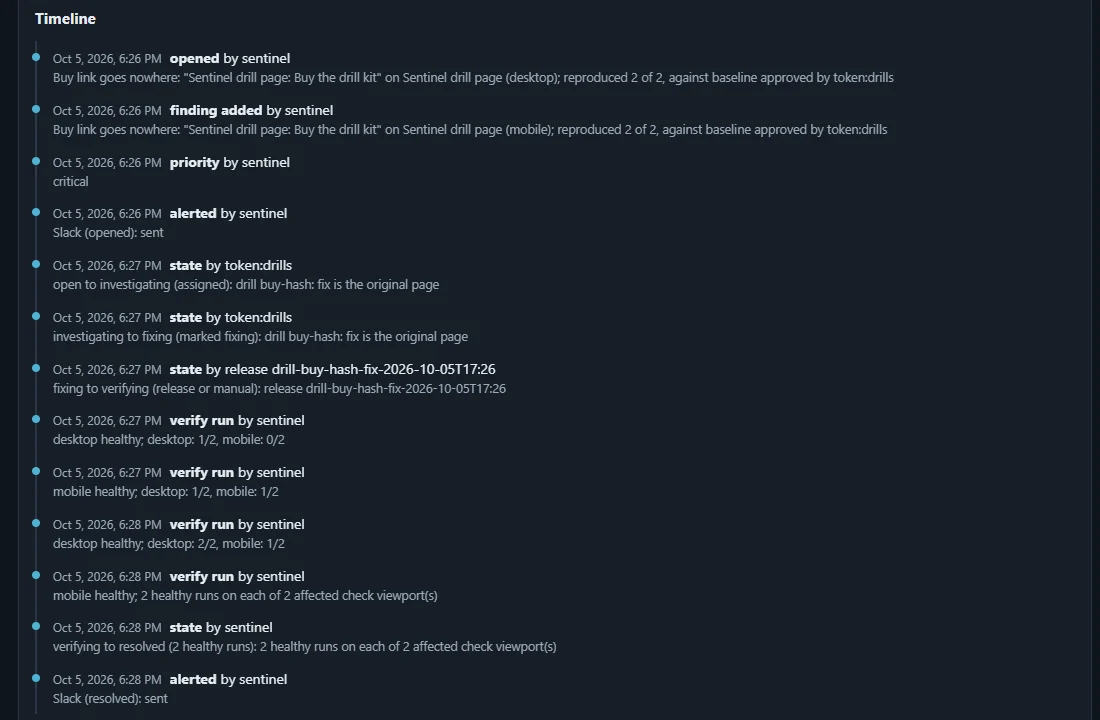
Timeline · from opened to resolved
Every drill counts toward a public measurement.
Sentinel scores itself against a 30-day exit condition: fewer than one false incident per site per week, and every seeded fault caught within 10 minutes. This drill adds to the second half: 2 of 2 measurable seeded faults caught within 10 minutes.
The same page also shows where Sentinel falls short today. It was watching for 91.1% of the time, below the 95% it needs, because it stopped completing checks for about 13 hours overnight into 1 October. The first drill of the three ran during that outage and is recorded as not measurable rather than dropped. The page says "measuring", day 7 of 30, and the exit condition is not met yet.
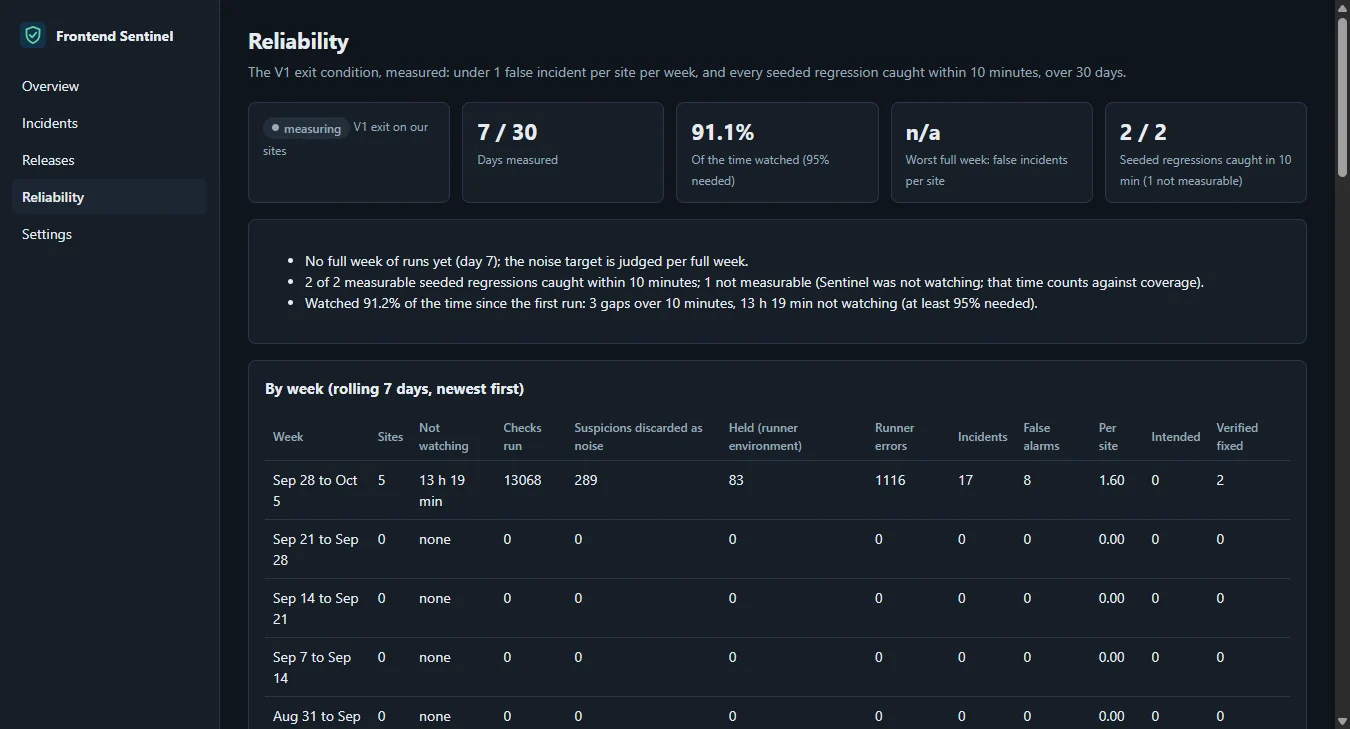
Reliability · the 30-day measurement, day 7
What the recording shows, and what it does not
- The video starts at the alarm. The first part of the recording, the quiet dashboard and the deploy, was captured in the light theme before the window was switched to dark, so it is cut. Steps one and two show that part as stills. The broken page was captured from a separate browser so the recorded window could stay on Sentinel.
- The deploy was reported to Sentinel. That is how a CI pipeline would normally work, and it starts the checks immediately. Without a release notice, detection waits for the next scheduled run of the check, or for Sentinel to notice the page's HTML change between runs.
- The drill stood in for the engineer. A script planted the fault, reported the release, moved the incident to fixing and deployed the fix. Detection, the explanation, the evidence, verification and closing were all Sentinel's own.
- This is our own site. The drill page and its check are ours. The measured run on design partners' production sites has not started; that is what the early-access pilot is for.
- One earlier drill matches it. The same fault on 1 October was caught in 1.91 minutes and verified closed in 1.71 minutes. Two drills are a small number, and this page does not claim a typical detection time from them.
- The signed-in account is hidden. The sidebar footer that names the account was hidden in the recording window only. Nothing else was edited.